
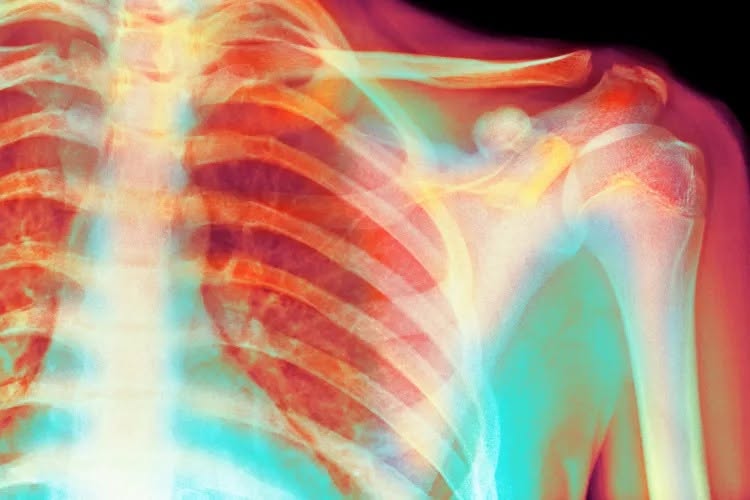
- Why we’re talking about this: Despite the growing popularity of body scans like DEXA, most younger women don’t benefit from routine screening unless they have certain risk factors.
- What to do: Talk to your healthcare provider about earlier screening if you have osteoporosis risk factors. Otherwise, focus on habits that keep bones strong throughout life.
- Looking ahead: Knowing when a bone density scan is—and isn’t—appropriate can help you focus on the prevention strategies that matter most for lifelong bone health.
Routine osteoporosis generally begins at age 65 for women.1 But some women get screened earlier—including the Kardashians.
On a recent episode of the Good Hang podcast, Kim Kardashian said she and her sisters, who range from their late twenties to late forties, receive bone density scans, called DEXA scans, every year. Not only that—a provider brings the device to them.
Most women don’t actually benefit from DEXA scans prior to their 60s. But experts say there are a few exceptions.
First, When Do Women Start Losing Bone Density?
According to Rachel Pessah-Pollack, MD, an endocrinologist at NYU Langone, women reach peak bone mass by their late 20s. Some people with osteoporosis risk factors, such as a family history of the disease or low body mass index, may begin losing density around that time. But for most women, bone density remains stable until late perimenopause, the transitional period before menopause that typically hits in the mid-40s.
At that time, bone density begins to drop rapidly, largely because of falling estrogen levels, Pessah-Pollack explained. Bone loss accelerates most sharply one to two years after the final menstrual period, typically between the ages of 45 and 55, and then continues at a slower rate.2
Other factors can contribute to bone loss throughout life, according to Deborah Sellmeyer, MD, a clinical professor of medicine at Stanford University who specializes in metabolic bone disease. These factors include medications such as steroids, poor nutrition, malabsorption, and age-related changes like altered calcium and vitamin D metabolism, muscle loss, and declining kidney function.
How Do DEXA Scans Work?
DEXA, short for dual-energy X-ray absorptiometry, is a quick, painless scan that uses low-dose X-rays to measure bone density. It works by assessing the amount of calcium and other minerals in bones—typically in the spine and hip, and sometimes in the forearm if either of those sites is not usable—and translating that information into a score, Sellmeyer explained.
Results include a T-score, which compares your bone density with that of a healthy young adult, and a Z-score, which compares bone density among people of the same age and sex, according to the Centers for Disease Control and Prevention.3 The T-score is used to diagnose osteoporosis and osteopenia (an early sign of osteoporosis) in postmenopausal women and men over 50, while the Z-score is more commonly used for premenopausal women and men younger than 50, Sellmeyer said.4
The U.S. Preventive Services Task Force recommends that all women at average risk for osteoporosis receive a DEXA scan beginning at age 65, with earlier screening for those at higher risk.1
Are There Benefits to Getting a DEXA Scan Before Age 65?
According to Stellmeyer, it’s not usually helpful for women to receive a bone density scan before menopause, technically defined as 12 consecutive months without a period. Younger women have a very low fracture risk, she said, so measuring bone density typically isn’t useful unless there are indications of skeletal fragility, such as using medications like prednisone or estrogen suppressors or having a history of low-impact fractures, an eating disorder, irregular periods, or celiac disease.
However, Stellmeyer said that routine DEXA scans during late perimenopause or shortly after menopause could be helpful as a way to catch low bone density earlier and potentially prevent fractures. That said, there’s a lack of large-scale studies with long-term follow-up demonstrating that this approach improves outcomes, she added.
Cost is also a consideration. Insurance typically won’t cover bone scans before age 65 unless a health care provider determines that a patient is a candidate for one, Pessah-Pollack noted. In those cases, a letter of medical necessity may be needed. Without insurance coverage, DEXA scans can cost up to a few hundred dollars.
But even if younger, low-risk women are willing to pay for a scan, that doesn’t mean it will be helpful for them, Stellmeyer said. “Knowing the result may offer no benefit, only create stress, and potentially lead to inappropriate treatment that would not be able to further reduce the young woman’s already low fracture risk,” she said.
How to Keep Your Bones Strong
Instead of getting a scan that you may not need, experts said a better focus earlier in life is preventing bone loss through healthy lifestyle habits. Stellmeyer noted that these steps can reduce much of a person’s fracture risk.
“Adequate nutrition and physical activity to maximize bone growth are critical” at every stage of life, from childhood through adulthood, she explained.
On the nutrition front, getting enough vitamin D, protein, and especially calcium can make a real difference for bone health. Pessah-Pollack recommends 1,000 mg of calcium per day for women ages 19 to 50 and 1,200 mg per day for women over 50, ideally from food, though supplements can help fill nutritional gaps.
It’s also important to avoid smoking and limit alcohol consumption. Keep in mind that some medications, such as steroids, can accelerate bone loss.
For postmenopausal women, research suggests that exercise, particularly a combination of aerobic and resistance training, can significantly slow bone density loss.5 Stellmeyer also recommends balance training to help reduce falls and prevent fractures.
As Stellmeyer said, having healthy bones “is a life-long endeavor, and we all should be implementing age-appropriate measures to maximize our skeletal health.”
