
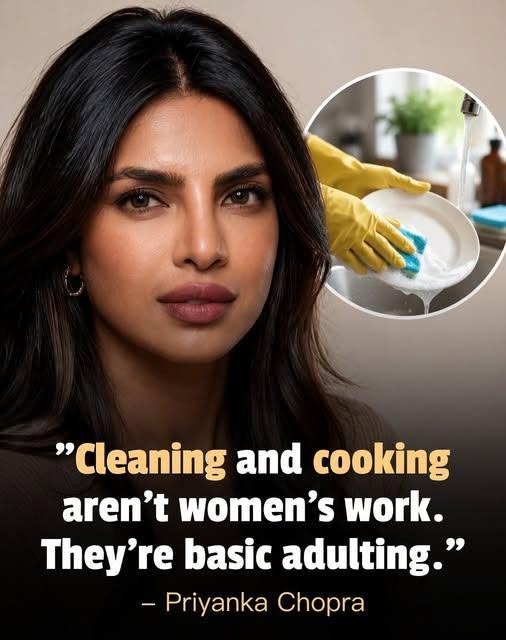
Actor Priyanka Chopra Jonas has once again sparked a worldwide conversation—this time not about movies or fashion, but about everyday life at home.
Speaking during a panel at the Cannes Lions International Festival of Creativity in June 2026, Chopra challenged one of society’s oldest gender stereotypes with a statement that quickly spread across social media:
“Cleaning and cooking aren’t women’s work. They’re basic adulting. Don’t confuse gender with laziness.” (The Indian Express)
Her words resonated with millions, while also reigniting debates about household responsibilities, modern relationships, and traditional family roles.
A Simple Statement With a Powerful Message
For generations, many cultures have assigned cooking, cleaning, laundry, and childcare primarily to women, regardless of whether both partners work full-time.
Priyanka Chopra argued that these everyday responsibilities should no longer be viewed through the lens of gender.
Instead, she described them as essential life skills that every adult should learn.
Her message was straightforward: knowing how to prepare a meal, clean a home, or manage daily chores isn’t about being a man or a woman—it’s about being capable and independent. (The Indian Express)
Why Her Comments Went Viral
The quote quickly spread across news outlets and social media because it touched on an issue many families experience every day.
Millions of couples continue to negotiate questions like:
- Who cooks dinner?
- Who cleans the house?
- Who does the laundry?
- Who manages groceries?
- Who cares for children?
- Who organizes household schedules?
For many people, these aren’t just chores—they’re symbols of fairness, respect, and partnership.
Chopra’s comments challenged the long-standing assumption that domestic work naturally belongs to women.
Household Chores Are Life Skills
One of the strongest parts of Chopra’s message was her emphasis on independence.
Cooking isn’t only useful for feeding a family.
It also allows individuals to:
- Prepare healthier meals.
- Save money.
- Become more self-sufficient.
- Reduce reliance on takeout.
Similarly, cleaning isn’t simply about appearance.
Maintaining a clean living space contributes to:
- Better hygiene.
- Improved mental well-being.
- Reduced stress.
- Greater organization.
These are practical skills that benefit everyone regardless of gender.
The Changing Role of Modern Families
Family dynamics have changed significantly over the past several decades.
Today, many households have:
- Two full-time working adults.
- Shared parenting responsibilities.
- Flexible work schedules.
- Remote work arrangements.
Because both partners often contribute financially, many people argue that domestic responsibilities should also be shared in ways that feel fair for each household.
Rather than following traditional expectations, many couples divide tasks based on schedules, preferences, and individual strengths.
Not Everyone Agreed
As expected, Chopra’s comments generated mixed reactions.
Many praised her for promoting equality and encouraging men to become more involved in household responsibilities.
Others argued that traditional family roles continue to work well for many families and shouldn’t automatically be viewed as outdated.
Some emphasized that successful relationships don’t necessarily require every chore to be split exactly 50-50.
Instead, what matters most is that both partners feel respected and satisfied with how responsibilities are shared.
The wide range of responses demonstrated just how personal this topic can be.
Equality Doesn’t Always Mean Identical Roles
Relationship experts often point out that equality doesn’t necessarily mean every task is divided perfectly down the middle.
Instead, healthy relationships usually involve communication and mutual agreement.
One partner may enjoy cooking while the other prefers cleaning.
Someone who works longer hours outside the home may contribute differently than someone with a more flexible schedule.
The key is that responsibilities are shared through cooperation rather than expectation based solely on gender.
Why Gender Stereotypes Persist
Traditional expectations surrounding household work developed over centuries when economic and family structures looked very different.
Historically:
- Men often worked outside the home.
- Women were more likely to manage domestic responsibilities.
- Social expectations reinforced these divisions.
Modern society has changed dramatically, yet some cultural attitudes remain.
As more women pursue careers and more men participate actively in parenting and household management, these traditional roles continue to evolve.
What Research Says About Shared Responsibilities
Numerous studies examining family relationships suggest that couples who perceive household responsibilities as fair often report higher levels of relationship satisfaction.
Importantly, fairness doesn’t always mean identical workloads.
Instead, satisfaction often depends on whether both partners believe responsibilities are distributed in a way that respects each person’s time, effort, and circumstances.
Communication plays a much larger role than rigid formulas.
Basic Adulting Means Independence
One reason Chopra’s quote resonated with younger audiences is its emphasis on independence.
Whether someone lives alone, with roommates, or with a partner, basic household skills remain valuable.
These include:
- Cooking simple meals.
- Cleaning regularly.
- Doing laundry.
- Grocery shopping.
- Managing household finances.
- Organizing daily routines.
Learning these skills helps people become more confident and self-reliant throughout life.
Social Media’s Role in the Conversation
Platforms like Instagram, TikTok, and X quickly amplified Chopra’s remarks.
Supporters praised her for challenging outdated stereotypes, while critics questioned whether traditional roles were being unfairly dismissed.
The online discussion reflected broader cultural conversations taking place around the world regarding work-life balance, parenting, gender expectations, and equality.
Common Misunderstandings
Myth: Priyanka Said Traditional Families Are Wrong
Her comments focused on challenging the idea that household chores should automatically belong to women, rather than criticizing families who voluntarily choose traditional arrangements. (The Indian Express)
Myth: Equality Means Splitting Every Chore Exactly in Half
Many relationship experts emphasize flexibility rather than strict mathematical equality.
Myth: Cooking and Cleaning Are Women’s Natural Responsibilities
These are learned skills that anyone can develop with practice, regardless of gender.
Myth: Shared Chores Eliminate Relationship Problems
While cooperation can reduce conflict, successful relationships also depend on communication, trust, respect, and shared goals.
Final Thoughts
Priyanka Chopra’s comments at Cannes Lions reignited an ongoing conversation about gender roles that extends far beyond celebrity headlines. By describing cooking and cleaning as “basic adulting” rather than women’s work, she challenged traditional assumptions about who should be responsible for everyday household tasks. (The Indian Express)
Whether people agree or disagree with her perspective, the discussion highlights how family roles continue to evolve across different cultures and generations. For some households, traditional arrangements remain the preferred choice. For others, shared responsibilities better reflect modern lifestyles and partnerships.
Ultimately, there is no single model that works for every family. What matters most is open communication, mutual respect, and an approach to household responsibilities that both partners consider fair. As society continues to change, conversations like this encourage people to think more critically about long-held assumptions—and to define successful relationships on their own terms.
